Showing posts with label Achnamara. Show all posts

Thursday, 7 November 2013

Beekeeping at Seafield - Again

In 2009 I wrote about our first foray into beekeeping or rather, bee watching. The winter of 2009/10 proved to be exceptionally cold and when it became warm enough to inspect the hives, we discovered that the two colonies had not made it through to the spring. We hadn't really learned much about beekeeping so had no idea why they perished or what we could have done about it. We were not totally put off but getting new bees didn't seem to be easy.
In 2012 we had the opportunity of buying a nucleus of bees from a friend who lives nearby. We spent a fortune on the accoutrements of beekeeping - a couple of hives, another suit, smokers, frames, foundation - the list goes on.
We collected the bees - five frames of worker bees, stores, brood and a queen bee and transported them to their new apiary - in a sunny spot well away from the house and cottages. A fence was constructed to keep badgers and deer away from the hives although we hadn't thought about the pine marten which shredded the insulation under the hives in its attempt to get at the bees and their honey.
We headed off to Colonsay to attend a weekend course with Andrew Abrahams, a hugely knowledgeable beekeeper and champion of the native black bees. A huge amount of information was on hand, we may even have manage to absorb some of it.
Within a few days of our return we faced our first challenge - our bees had swarmed. Our inexperience meant we had failed to give the bees enough room and hadn't noticed the formation of queen cells, a certain sign of the preparation to swarm. The swarm was captured and placed in a new hive but again our inexperience showed and a failure to place a queen excluder on the bottom of the hive, allowed the colony to continue its determined mission to find a new home. If we had kept the queen captive, the colony would not have left.
A friend came and removed frames with queen cells to another hive, leaving another two frames with queen cells in the original hive. This seemed drastic with depleted numbers but it did the trick. Another small swarm appeared which we manage to catch - this time keeping them captive. We reduced the queen cells to one in each hive and waited. And waited. And waited. After a period of time determined by several bee books, we inspected the hives to find no sign of queens or eggs or brood. Despondency. So we waited some more and amazingly discovered that we had three queens, all mated and all producing new bees. Elation. It was fortunate that our bees knew what they were doing and our ignorance wasn't a problem for them. A yellow dot was applied to identify her as a 2012 queen.
This is the point at which we might have expected to be harvesting the fruits of our bees' labours. The long queenless gap and the slow build up of the colonies meant that not a drop of honey was to be seen apart from the meagre stores we left them with.
Our previous winter experience was a cause for anxiety as we headed into the colder months. We fed them, put in insulated dummy boards and carpet in the roof and crossed our fingers. The winter wasn't particularly cold but the spring was a long time coming so we were not able to inspect our bees properly until nearly the end of April. Our smallest colony had perished. Two and a half frames of bees was marginal for getting through the winter but we couldn't bring ourselves to kill one of our queens and amalgamate the two smaller colonies. Fortunately our two stronger (but still quite small) colonies made it and spent the summer building up their numbers and building wax comb for egg laying and honey and pollen storage.
A course in Moray with Tony Harris on queen rearing, gave us confidence to have a go at producing new queens using 'mini nucs' - tiny polytyrene hives which by some magic, produce mated, laying queens far more quickly than in a conventional hive. We persuaded the bees to produce new queen cells by doing an 'arificial swarm' removing the queen and flying bees to another hive, leaving the workers queenless and ready to raise new queens. The queen cells when nearly ready to emerge were put into the mini nucs with a couple of cups full of bees. We also left a queen cell in the hive so had three chances of new queens. In the event, only one queen was produced in one of the mini nucs. The second queen cell was 'torn down' by the workers and we don't know what happened to the one in the hive. We tried again later to persuade the bees to produce queen cells but it wasn't successful - maybe it was too late in the season.
Now here we are going into winter again. This time with three colonies of similar size, one lovely new queen and two queens which have now done two seasons so will need to be replaced in 2014. They have been fed with sugar syrup, wrapped up warmly and left with good quantities of honey. There are no signs of varroa or other disease (although it is by no means certain that we would spot them all). Slabs of Ambrosia fondant have been put in the hives and we have constructed wooden hive cosies to give them some additional protection from the rain, wind and cold.
They are still flying on good days, adding ivy pollen and nectar to the stores. And best of all, we were able to harvest some of the precious liquid gold - 20 jars of honey which must have cost about £100 each.
The fingers are once again firmly crossed for their winter survival. We may not be about to get rich from honey production but we have learned a lot and just hope that we get a chance to benefit from our experience in 2014. Thanks bees for all the lessons, the honey, and the entertainment and for a whole new way of gardening and observing. See you next year.

Friday, 13 September 2013

Website Woes

Much as I enjoy making things, growing things and generally being as independent as possible, there are some things I choose not to do myself, preferring to employ someone who is competent in whatever area I find myself hopelessly inept. Web Design is one such area so when I finally realised that a web site was necessary to showcase our holiday cottages, I cast around for recommendations for web site designers and hosts. A host was found, a site designed and as far as I knew (we only communicated by email) a working relationship was established, fees paid and service was rendered.


Four years on, in the middle of a busy season, an email arrives. 'I am closing my business, you can't have your hosting fees back and if you want your domain name and website, you'll have to pay me for it'. What?!? I thought I had paid for it? Silly me. I am happy to pay for a job well done, but only once. Not twice. A charge would be understandable if I was choosing to change providers but this was a unilateral declaration of termination.

All this is a long winded way of letting you know that we are still here but if you try to access the website at the moment you will get the message 'Directory Listing Denied
This Virtual Directory does not allow contents to be listed'.


A new website should be available soon. Until then, you can find us at www.scotland2000.com/seafield, on Facebook at Seafield Farm Cottages and Craft and on Twitter at seafieldfarm. You can email seafield3@btinternet.com

Friday, 7 December 2012

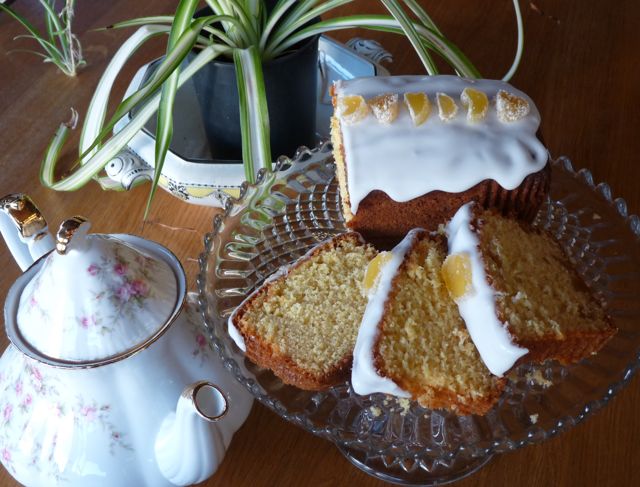
Preserved Ginger Cake

Preserved Ginger Cake


This cake has gone down well at recent village hall and basketmaking events and with our vistors to the holiday cottages. It's a cut above the usual gingerbread and very easy to make.

Makes 3 loaf cakes (1lb size)

450 gm Self Raising Flour
50 gm Ground Almonds (optional - you can substitute with flour)
6 large Eggs
325 gm Sugar - white or soft brown
325 gm Butter or Soft Margarine
2 tablespoons Golden Syrup (or syrup from jar of preserved ginger)
4 teaspoons Ground Ginger

175 gm Preserved or Crystallized Ginger, chopped

Icing (Optional)
250 gm icing sugar
lemon juice

Put flour, ground almonds (or flour), eggs, sugar, butter/margarine, syrup, ground ginger into the mixing bowl. Beat all together until well mixed. Add milk if required to make a soft dropping consistency. Add chopped ginger, keeping some aside for decoration. Divide mixture between 3 loaf tins or 2 x 23 cm round tins. Greaseproof cake tin liners make tin lining easy.

Bake in fan oven 160C for 45 - 50 minutes. Adjust temperature if you have a different type of oven.

Make icing and coat the top of the cakes when cool. Add ginger for decoration.

Monday, 18 June 2012

Seafield Farmhouse - Available for Holidays

A year ago while on holiday in our campervan on a storm bound Hebridean island we thought about how little space we needed and decided to spend the winter preparing to move out of our house so that we could let it during the summer months. With all the children having flown the nest, it is a large space for two of us and we are rarely indoors during the summer. We arrived home to the discovery that we had a double booking and so some very understanding visitors were the first to sample staying in Seafield Farmhouse after our rather hasty preparations.


A year on and the house is almost prepared for public consumption. We were nearly ready when our visitors in Byre Cottage needed to extend their stay for a fortnight and it is amazing what you can achieve with two day's notice. Needless to say, the winter had been spent on the sofa, close to the woodburner rather than performing admirable feats of de-cluttering. Letting Seafield Farmhouse is not a new concept. Granny and Grandpa Livingston sent the children to relatives in the summer so that the house could be let to families who came up for six weeks at a time. We have a copy of a delightful diary kept by the daughter of one such family who stayed here in 1928 for whom Granny cooked 'monstrously good suppers'. In the 21st century, the accommodation will be strictly self catering!


We are not sure of the exact age of the house. It has been described as 150 years old for at least the last 40 years. It was built as part of the Poltalloch Estate and sold to the Forestry Commission in the 1930's. Grandpa Neil Livingston arrived from the Isle of Luing at the beginning of the last century when Seafield was a sheep farm. The Forestry Commission planted the hill with sitka spruce and Seafield became a sixty acre smallholding comprising mainly of rock and bog. His son Jimmy Livingston took over the farm and also worked full time for the Forestry, operating a winch. In time, his son, my husband, James Livingston came home to look after the place and was also employed by the Forestry Commission. As a tenant, James was able to buy Seafield in the late 1980's and could then diversify into holiday lets, sawmilling and firewood processing. He has recently taken early retirement and so we hope to be able to continue to improve the facilties we provide so that many more people can share the stunning place we are fortunate to be able to live in. That's when James isn't fishing of course.


On the ground floor, the house has a large, 30 ft long conservatory which we added in 1997. This is the main living and dining area and has a woodburning stove. Off the conservatory is a large kitchen with units made by a local craftsman with reclaimed timbers from redundant Crinan Canal lock gates. It has a dishwasher and dual fuel cooker with gas hob and electric oven. There is a combination microwave and large fridge plus the usual small appliances.


Off the kitchen is a utility room with washer and freezer which is accessible from the kitchen but also has a separate exterior door. We need access to this space from time to time as it houses our freezer and a large oven which I need to use occasionally - but we will be as unobtrusive as possible.


The hallway which has a small cloakroom, leads to a family suite of double bedroom with adjacent twin bedroom and ensuite facilities.


Upstairs, there is a large double bedroom with king sized bed and a bathroom with bath and shower. The second bedroom is not available for letting as it is in need of complete refurbishment and will be used for storage of all the things we don't know what to do with.


Central Heating and hot water are from the log fired boiler and there is a woodburner in the conservatory. During warmer weather, the boiler is off and heating and hot water are provided by electricity - mostly generated by the photo voltaic panels.


Seafield Farmhouse is available for holidays during June, July and August. We may extend into September if all goes well. Sorry, no pets and no smoking. Children are welcome. With Byre and Stable Cottages just next door, there is plenty of scope for larger family groups who want to spend time together while enjoying their own space.

To check availability, please go to www.seafieldfarmcottages.co.uk and check the search availability button, email info@seafieldfarmcottages.co.uk or phone 01546 850274


Sunday, 29 January 2012

Walking in Knapdale Forest

Many of our visitors enjoy walking and here in Knapdale there are several routes on forest roads where you can walk for miles without seeing another person.  Some routes are waymarked but many of the forest roads are part of the forest harvesting operation and care should be taken if machines are working.  Some forest roads are quite featureless and it can be easy to get lost - I have taken a wrong turning more than once - usually when walking with a friend and being more intent on conversation than the route.  Keep an eye out for deer, badgers, foxes, osprey (summer only), buzzards, jays and all manner of small finches and tits - and of course the newly resident beavers which are mainly spotted in the early morning and late evening.


This walk starts at Seafield Forest gate,  approximately 150 metres north of Seafield Farm, Achnamara.  There is room to park at the entrance but obviously if you are staying with us, you won't need to drive.  If you choose to do the walk anti-clockwise, you should park at Achnamara Village Hall, half a mile south of Seafield Farm and reverse the instructions.


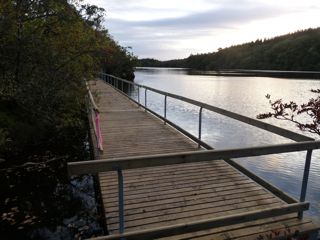
Follow the forest road straight up the hill.  There is a burn (stream) on your left hand side.  Pass a side road on your left and keep on up the hill.  Soon you will come to a right turn.  If you wish to take a little diversion, it is only a short distance to the Lily Loch where there is walkway and a bench.  This is an idyllic spot to sit and enjoy the sounds of birds and small brown trout breaking the surface of the loch.  There is a good display of waterlilies in the summer and it's a good place to see dragonflies and damselflies.


Retrace your steps to the junction and turn left.  You will be able to see Seafield Loch on your left hand side.  A few yards along, there is a small jetty for Lochgilphead Angling Club.  Directly opposite the jetty is a lodge built by a pair of beavers introduced to the area by the Scottish Beaver Trial.  Being built of sticks and mud and being quite a flat construction, it would be easy to miss it. 


As you continue along the side of the loch, you may notice some beaver gnawed trees although most of the activity is on the far side of the loch.  At the end of the loch, there is another walkway on the left hand side leading to another bench at the north end of the loch with more lovely views to sit and enjoy.


Continuing along the forest road, you will pass a turning to the left.  This side road is permanently blocked by flooding.  Keep on up the hill until you reach a junction.  Take the right turn and continue through the Sitka Spruce plantation.  About an hour into the walk, you come to an open area which is fenced off on the left hand side - this was once a granite quarry for construction of the forest roads.
Keep on following the road past a marshy area to the left which is a favourite spot for deer to wallow in the mud.  Keep following the main forest road around the bends, through an area of cleared forest and downhill until you reach a crossroads.


Take the right turn and keep going ignoring the next turn to the left.  The track takes you downhill, passing a waterfall on the left.  Continue through the plantation of old trees on the right, across a concrete bridge to a forest gate.  Turn right at the gate which takes you to the Village Hall where you turn right.   As you cross the stone bridge in the village look up to the right where you will see Achnamara House.  For many years this was an outdoor centre, visited by hundreds of children and adults from other parts of Scotland.  Sadly, the once fine Dower House and Shooting Lodge of Poltalloch Estate, is currently in a poor state of repair after many years of neglect since being sold by Glasgow City Council.


It is about half a mile from here, through Achnamara back along the single track road with Loch Sween on your left hand side, back to Seafield gate where you started.

This walk is approximately five miles long and takes about one and a half to two hours depending on how fast you walk.

To check availability of our cottages, click on the green search button below.

Monday, 14 February 2011

Winter Arrives Early

For years our winters have mostly been green, damp and dreary. After the freezing conditions of early 2010, we were not expecting a repeat performance at the end of the same year. Once again, water supplies froze up and we were glad of our firewood stocks to keep ourselves and our visitors warm.


The cold clear air gave us stunning views of the area and beautiful sunsets. We are lucky to have fantastic walks around Achnamara and rarely feel the need to go further afield. Loch Sween froze over completely at Achnamara; a sight not seen for many years.
The freshwater lochs were covered with a thick layer of ice for several weeks.


The winter solstice coincided with a lunar eclipse and Kilmartin House Museum organised a guided walk around some of the Cairns and Stone Circles of Kilmartin Glen. The cold was toe numbing but the atmosphere and the sunrise were worth the discomfort. Cups of coffee and sausage sandwiches in the museum cafe helped revive the intrepid souls who braved the elements at 8.00 am.


The thaw started on Christmas morning so after weeks of very festive, Christmas Card weather, green grass began to show through the snow. January was unseasonably mild but after the extra work and stress of freezing conditions I have vowed never to complain about rain and mud ever again.


Now we are well into February and the days are beginning to lengthen and signs of spring are appearing. The hens are starting to lay again and we hope to raise some new chicks in a few weeks. The cockerel has proved to be extremely bad tempered so as soon as we have a batch of his progeny, he will make a very delicious casserole. Newts have appeared in the ditch next to the road up to Seafield Loch. Blue tits are emptying the peanut feeder as quickly as we can fill it and there are delightful drifts of snowdrops in woodland and churchyards.


We have not had any sightings of beavers for some time due to the long hours of darkness and for a few weeks they will have been laying low in their lodges. Now the ice has melted and temperatures risen, their activities are easy to spot. According to the minutes of a meeting of the Species re-introduction Forum in August, the juvenile male on Loch Linne has dispersed from its family group but we have had no information on this from the Beaver Trial Team. Hopefully, we will learn more at the next stakeholder meeting in March. The lodge on Loch Linne is covered with de-barked sticks to the beavers must be using it as a feeding station as well as living quarters.

Tuesday, 12 October 2010

Autumn in Argyll

We have enjoyed a very fine Autumn here on the West Coast. Temperatures have been higher than usual, apart from two nights of frost at the end of September and the occasional rainy mornings gave way to glorious afternoons and evenings. Swimming on Loch Sween has extended into October. The wet suit has been hung up for the last time on several occasions, only to be taken out again for 'one last swim until next year'.


After a spring and summer of hobbling around with an injured knee, James finally managed to get up to his favourite fishing spot. The Wolf Loch above Achnamara sounds impressive and dramatic but the one time I made it up to the top of the Cruach which involves sprachling over rough terrain and climbing over a deer fence, I was surprised to see this much lauded loch was a small and weedy body of water. However, it's modest size and difficulty of access is compensated for by the fantastic trout that it holds.


The four chicks raised earlier in the year all turned out to be cockerels, or dinner as I like to call them. The new hen house was finally finished and all the hens, with their new cockerel are now installed in a very substantial and hopefully, predator proof, house. It has an automatically opening and closing pophole so next summer, we hope to be able to enjoy nights away while the chickens put themselves to bed.


The Moine Mhor north of the Crinan Canal, is the remnant of an ancient raised bog which is managed by Scottish Natural Heritage. It is a fantastic place for wildlife and you can spot hen harriers and short eared owls. Earlier in the year we had a close encounter with five short eared owl chicks which chose to sit in the middle of the road. Take a turn to Crinan Ferry which has a good beach and on the way enjoy views to Duntrune Castle, home to the Malcolms of Poltalloch.


The garden has been very productive this summer with great crops from most plantings. The only disappointments have been the onions and the celeriac – unless they are supposed to be golf ball size?


We haven't managed to get away for a holiday this autumn but the great weather has made up for it. A favourite outing is to take the camper van down to the point of Knap, have a walk and then enjoy a cup of tea and some cake while enjoying the views across to Jura. Simple pleasures! The landscape opens up as you drive down the peninsula, the hills are kept bare by sheep and deer so it is a totally different experience from being here at the head of the loch, surrounded by trees. A notable landmark is Castle Sween which is one of the oldest Castles in Scotland.


The Autumn Stag Rut has been in full swing with deer bellowing all around Achnamara. I don't remember them being so noisy in the past and it has been unusual for them to be in the fields around the house and village rather than further up in the hills.


Yet more beavers have been added to the Beaver Trial. At the last count there were twelve beavers in the trial area which is one more than the trial started with eighteen months ago. The Dubh Loch family produced one kit this year, as did the family on Loch Linne. A new pair were imported from Norway and released onto Creag Mhor Loch but then moved to an adjacent, less accessible unnamed loch. Another male beaver was released to join the lone female on Seafield Loch in an attempt to make a fourth potential breeding pair. We don't know yet if this has been successful. The Dubh Loch beavers have been extending their dam and increasing the area of flooding. Unfortunately this has now extended beyond the entrance to the new path installed to bypass the flooded 'Beaver Detective Trail'. A very impressive looking pontoon on Coille Bharr will take walkers onto the loch, just below the beaver dam. It is not yet accessible but will hopefully be completed before too long.